Monthly Archives: August 2026

What Is Your Yard For?

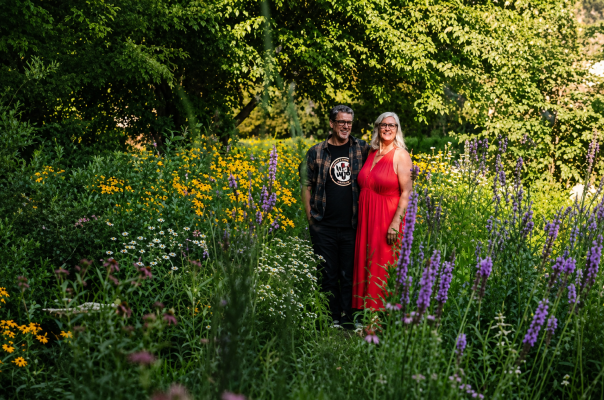
Photo from the Guardian


What I Noticed

While taking my daily virtual field trip through the news, I noticed an article about a couple in Highland Park, Illinois, who gradually transformed much of their conventional lawn into a landscape filled with native plants.

What had once been primarily grass now attracts birds, butterflies, bees and other wildlife.

At first, I noticed the article because of the nature connection. I have spent much of my life thinking about landscapes, wildlife habitat and conservation. But as I continued reading, I began thinking about something broader.

What It Made Me Think About

What is a yard actually for?

That sounds like a ridiculously simple question. But how often do we actually ask it?

Many of us acquire a house with a lawn because that is what came with the house. We mow it. Maybe we fertilize it. We control weeds. Some people water it. We buy equipment to maintain it or pay someone else to do the work.

And year after year, we keep doing it.

But why?

There are plenty of good answers. A lawn can be a wonderful place for children to play, for a dog to run, for friends to gather or simply for someone who enjoys the appearance of an open green space.

But what about the portions of our yards that we maintain primarily because that’s what we’ve always done?

That is what this article made me ponder.

A yard is an asset. And like any asset, perhaps it is worth occasionally asking what we want it to do for us.

Could part of it grow food?

Could part provide habitat for birds and pollinators?

Could a tree provide shade that makes sitting outside more enjoyable?

Could a small garden give us flowers to photograph, butterflies to watch or simply a reason to walk outside every morning and see what changed overnight?

Could changing part of a lawn actually reduce some maintenance while increasing enjoyment?

And there is no single correct answer.

The point isn’t that everyone should replace their lawn with native plants.

The point is to notice the lawn in the first place.

Instead of seeing it simply as something that needs to be mowed again, perhaps we could occasionally stop and ask:

What is this little piece of land for—and what would I like it to provide?

Maybe the answer is grass.

Maybe it’s tomatoes.

Maybe it’s a pollinator garden.

Maybe it’s a shade tree and a comfortable chair.

Maybe it’s a place for the grandchildren to play.

Maybe it’s some of each.

That seems to me like a small example of The Stewardship Way.

Notice something we already have.

Become curious about it.

Ask whether we’re managing it intentionally or simply continuing what we’ve always done.

And then decide whether anything needs to change.

Sometimes the answer may be nothing at all.

But we wouldn’t know that until we stopped long enough to notice.

Read the Article Yourself

The article that started me pondering this was “How one American couple ditched their lawn and created a wildlife haven.” It tells the story of an Illinois couple who gradually changed their conventional yard and what happened as wildlife began returning.

Read the article in The Guardian

A Question to Ponder:
If your yard is an asset, what return would you like it to provide—not simply in dollars, but in time, enjoyment, food, beauty, wildlife, purpose or memories?


Another Jack-o’-Lantern

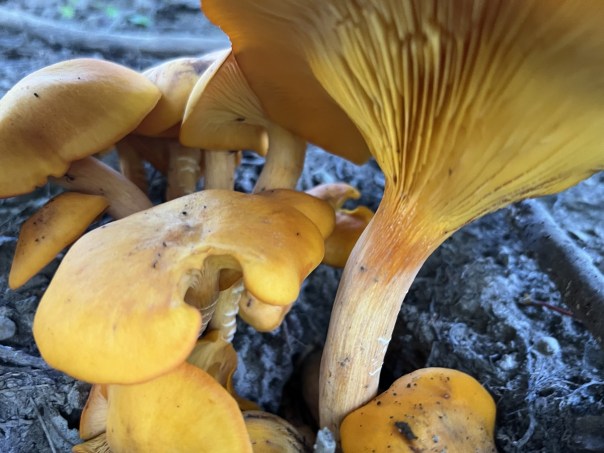
A few days ago, I took another short walk down Waldenmaier Road and noticed another small patch of bright orange Jack-o’-lantern mushrooms growing at the base of a decaying tree.
Did you know?

Jack-o’-lantern mushrooms are bioluminescent. Their gills can produce a faint greenish glow in the dark through a chemical reaction similar to the one that allows fireflies to glow.

But there is more going on here than an interesting mushroom.

Fungi are among nature’s great recyclers. They help break down dead wood and other organic material, returning nutrients to the soil where they can become part of another generation of life.

The orange mushrooms are simply the part we happen to notice.

Much of the real work is taking place out of sight.

Sometimes stewardship begins by noticing what nature is already doing.

Before We Change a Place, Do We Know What It Is Already Doing?

What I Noticed

During my daily virtual field trip through the news, I noticed an article on a website about San José, California, and the city’s effort to make it easier to build small multifamily housing in existing residential neighborhoods.

There are plenty of stories these days about communities trying to increase housing supply, so that alone probably would not have caused me to stop.

What caught my attention were the exceptions.

What the Article Was About

San José is considering a process that would make some small multifamily housing projects easier and faster to approve. But the city is not proposing to treat every residential parcel exactly the same.

Properties in certain flood-prone areas, along riparian corridors, in environmentally sensitive locations, or containing significant historic resources would continue to receive additional review.

That made me stop.

San José has more than 30 streams and roughly 136 miles of riparian corridors. Those narrow pieces of land beside streams may perform several functions at the same time. They can carry and temporarily store water, provide wildlife habitat, support vegetation, influence water quality, offer recreational opportunities, and affect what happens upstream and downstream during heavy rainfall.

Yet on a zoning map, the same piece of land may simply look like a parcel where someone could build another home.

What It Made Me Wonder

That made me wonder whether one of the problems we sometimes create for ourselves begins with how narrowly we define an asset.

If we look at a piece of property only as a potential building site, then the obvious question becomes:

How much can we build there?

But what if the same land is already doing several other things?

What if it helps carry stormwater?

What if it provides room for a stream to move?

What if trees growing there help cool a neighborhood?

What if it provides wildlife habitat?

What if it contains something historically significant?

Suddenly the question becomes more complicated.

Maybe the first question should not be:

What could we put here?

Maybe it should be:

What is this place already doing?

What I Am Pondering

This does not mean that San José should not build more housing. Housing is also an asset, and communities have legitimate reasons to consider how existing neighborhoods can accommodate more people.

But perhaps good stewardship begins with a more complete inventory.

Before changing an asset, do we understand all of the functions it currently performs?

Who benefits from those functions?

What would be lost if they disappeared?

Could some of those functions be replaced somewhere else?

What would replacement cost?

And are there things that cannot easily be recreated once they are gone?

The same questions could be asked about a wetland, an old building, a golf course, a farm, a vacant lot, a neighborhood park, or even an apparently unused piece of land.

There may also be another important question:

Are we solving today’s problem in a way that unnecessarily limits the choices available to people tomorrow?

That does not mean preserving everything exactly as it is.

It means noticing what is already there before deciding what it should become.

What This Might Mean in Anyplace, USA

San José may be hundreds or thousands of miles from where most of us live, but the stewardship question is not really about California.

It could apply in Anyplace, USA.

A town wants more housing.

A developer wants to build on a wet field.

A community wants to widen a road.

A school district owns unused land.

A golf course closes.

An old factory becomes vacant.

A stream runs through property someone wants to develop.

A wooded parcel looks like an obvious place for another subdivision.

Before deciding what comes next, perhaps we should stop long enough to notice what is already there.

Not simply what we call it.

Not merely what the tax map says it is worth.

But what functions it performs, what history it contains, who depends upon it, and what choices changing it may eliminate.

That seems like a pretty good place for stewardship to begin.

Question to Ponder:
Before we decide what a place should become, have we taken the time to notice everything it already is?

Read the Article Yourself

This Field Note began with something I noticed while reading about San José’s proposed changes to its housing and land-use policies.

Don’t just take my word for it. Read the source material yourself. You may notice something I didn’t, wonder about something different, or come away with an entirely different perspective.

Click Here to read the plan.

Then ask yourself:

What did you notice? What did it make you wonder about?


Come wander and wonder with me.

Each day I take both real and virtual field trips looking for Notice Moments—things that cause me to stop, become curious and ask questions. Sometimes I find them along a trail or roadside. Sometimes I find them while reading the news. I don’t share them because I already know the answer. I share them because they seem worth noticing—and because you may notice something I missed.

A Journey Across the Road

While walking at Hollyhock Hollow a few days ago, I noticed this unusual creature slowly making its way across the gravel road. It is a hellgrammite, the aquatic larval stage of the dobsonfly.

For most of its life, it lived hidden beneath rocks in a clean, well-oxygenated stream, where it was an active predator. But when the time comes, it leaves the water and crawls onto land to complete one of the most remarkable transformations in the insect world.

To me, it was simply crossing a road.

To the hellgrammite, it was the final leg of a journey that had taken years.

It made me wonder how many extraordinary stories are unfolding beneath our feet every day—stories we never see because we never stop to notice.

Stewardship begins with noticing.

— Ron Dodson

I also can’t help but smile at the mystery behind the adult’s name. No one seems to know for certain why it’s called a dobsonfly. Perhaps somewhere in history there really was a Mr. or Ms. Dobson who admired them… or maybe even a distant relative. 😉